
AI is in a bubble – But that’s good for AI, and all of us
The AI is officially in a bubble. That’s not just okay – it’s essential.
History repeats itself
Although I strongly believe in the medium and long-term, AI will be the most transformative technology the world has ever seen, the path of its adoption and progress is based on humans and our ability and desire to understand, adapt to, and navigate change.
The path will therefore be like the .com bubble.
- Hype: Everyone loses their minds
- Cash grab: Investors throw money at anything with a “.com”. Extensive infrastructure and systems are put in place. Extensive risks are taken.
- Reality check: The bubble pops. Dreams shatter
- Phoenix rising: Real understanding, innovation, and application emerges from the ashes, built upon the vast resources that the investment enabled
- Integration: The technology implementations take shape, and they then reshape society and economies
The bubble isn’t a bad thing. It’s just a natural part of disruptive change at this level. It brings a level of investment and attention that would otherwise be impossible. And as AI has so many positive and negative potential outcomes, we should all look forward to it bursting. The AI bubble bursting will make AI solutions better and safer.
AI is in a bubble. It's bursting is good for AI, and for all of us. It will make AI solutions better and safer. - Noz Urbina (tinyurl.com/nozulinkedin) #AIBubble Share on X

Accelerating towards integration
The key to excelling with AI isn’t coding or engineering skills – it’s understanding how to structure your thoughts and information logically. The skills are proven and decades old, but they were just buried in the dark corners of the interwebs.
When I started working with structured content and semantic web technologies around the .com bubble, I had no idea how crucial these concepts would become. Back then, I landed in a small company in a small community pushing for intelligent content structuring, envisioning a future where multichannel delivery, personalisation, and automation would be the norm – and as a student fresh out of school, I assumed it was!
It was years later I started working in “mainstream” content and found out the manual, error-prone, duplicative grunt-work that was going on all over the content lifecycle.
Throughout my career, I’ve witnessed a constant that helps address this: the power of structured, logic-driven content. I’ve learned that it’s the mental models and logic behind effective content creation – whether for product pages or emails – that form the bedrock of content strategy.
What is the thinking – the “Why” – of how we create a product description, or a whitepaper, or a call to action? This reasoning drives a logical structure, which in turn drives automation, personalisation, reuse, omnichannel, and the rest.
As we enter an era where AI plays a pivotal role in content processes, I’ve found that my background in semantic structuring and content has become increasingly valuable. The key to leveraging AI effectively isn’t about writing code or using tools but about understanding how to articulate our mental models and content logic in a way that machines can understand and work with.
Moving beyond chatting: Quality in, quality out
By fostering a collaborative process that harmonises human intelligence with machine precision, and GenAI’s raw productive capacity (which is not precise! See also my LinkedIn Article “The Unreliable Computer Revolution”), we can achieve results that we could never accomplish otherwise.
We need to go beyond just spontaneous, freeform chatting with AIs – even though that’s the selling point from the main AI companies – and learn to structure our thoughts in ways that give the AIs the skills we need and help them reliably participate in our workflows.
Building templated approaches and repeatable, scalable, human-machine processes allows us to tackle complex content challenges and create more dynamic, personalised experiences for our audiences. In all my AI workshops, I’m trying to train content and design folks to not just chat, but build frameworks and configurations that create better AI contributors to their work.
AI needs great content
AI needs great content. But you can interpret that with some flex depending on your organisational context:
- For solo users: If you’re just making use of AI on your own, good can mean structuring and templating your thoughts and your requested output for consistency and comprehension.
- For team leads: For productivity an efficiency in a team or single business function, good means building coherent workflows of interlocking structured prompts and output templates from various AI contributors to support your team.
- For enterprise or department heads: As an enterprise omnichannel strategist, I include content models, knowledge models, and content design in my definition of “good” content – in addition to relevance, customer-centricity, readability and many other metrics. If you’re in an environment where you need complex, accurate, answers across large content sets, and if you’ve got a context where you can drive scaling this to the enterprise, that means building whole systems and infrastructure for managing logic and flow in your content across systems and touchpoints with “just enough AI” dotted across the tech stack. If you’re using it internally as a staff assistant, maybe you just need to make sure your AI isn’t trained on junk.
And we have proof!
On the one side, we have the current generation of AIs are being fed with “the net”, creating the largest-scale of examples of GIGO (garbage-in, garbage-out) ever, for example Google telling pregnant women to smoke or put glue on their pizza. On the other, there are many examples showing a better way: quality, not (just) quantity. Sébastien Bubec, Sr. Principal Research Manager in the Machine Learning Foundations group at Microsoft Research (MSR) said, “When we focused around the data and focused on really trying to craft data in a way that’s more digestible by the LLM at training time, suddenly we saw these incredible 1000x gains”. The results were from “Training data with ‘textbook quality’”, and he continued on to say, “The gold is in the data.”
Textbook quality: “When we focused around the data and focused on really trying to craft data in a way that’s more digestible by the LLM at training time, suddenly we saw these incredible 1000x gains… the gold is in the data.”
Although AI people call everything “data”, regardless of whether we’d call it “content”, the point is clear: Good content is needed to power the future of AI.
Embracing a double-edged sword
AI is powerful—for the good and bad. Yes, we need to dive deeper into AI-powered content and digital experiences. Yes, they are the future and for some lucky few, the present. But we must also pull back to ask broader questions about their psychological, social, and even cultural impacts.
The more basic AIs (and they are AIs) on social media, that have been in place a decade before the current generative wave, that learn our preferences or augment our reality were already creating so many harms I can’t begin to list them all here. The example I came across just this last week was from the Cleveland Clinic, whose researchers showed “Filters and editing can lead to low self-esteem, depression and even body dysmorphic disorder”.
Corporations apply psychological exploits to keep us hooked on their apps and devices (More on Skinner Box dynamics in apps). We’re also seeing that the world’s most powerful brands and countries are in an AI arms race that incentivises speed and profit over safety. AI acceleration far outstrips our ability to handle the change.

AI super-charges all of the previous digital risks. Even when we know it’s a generation, not reality, it still impacts our reality.
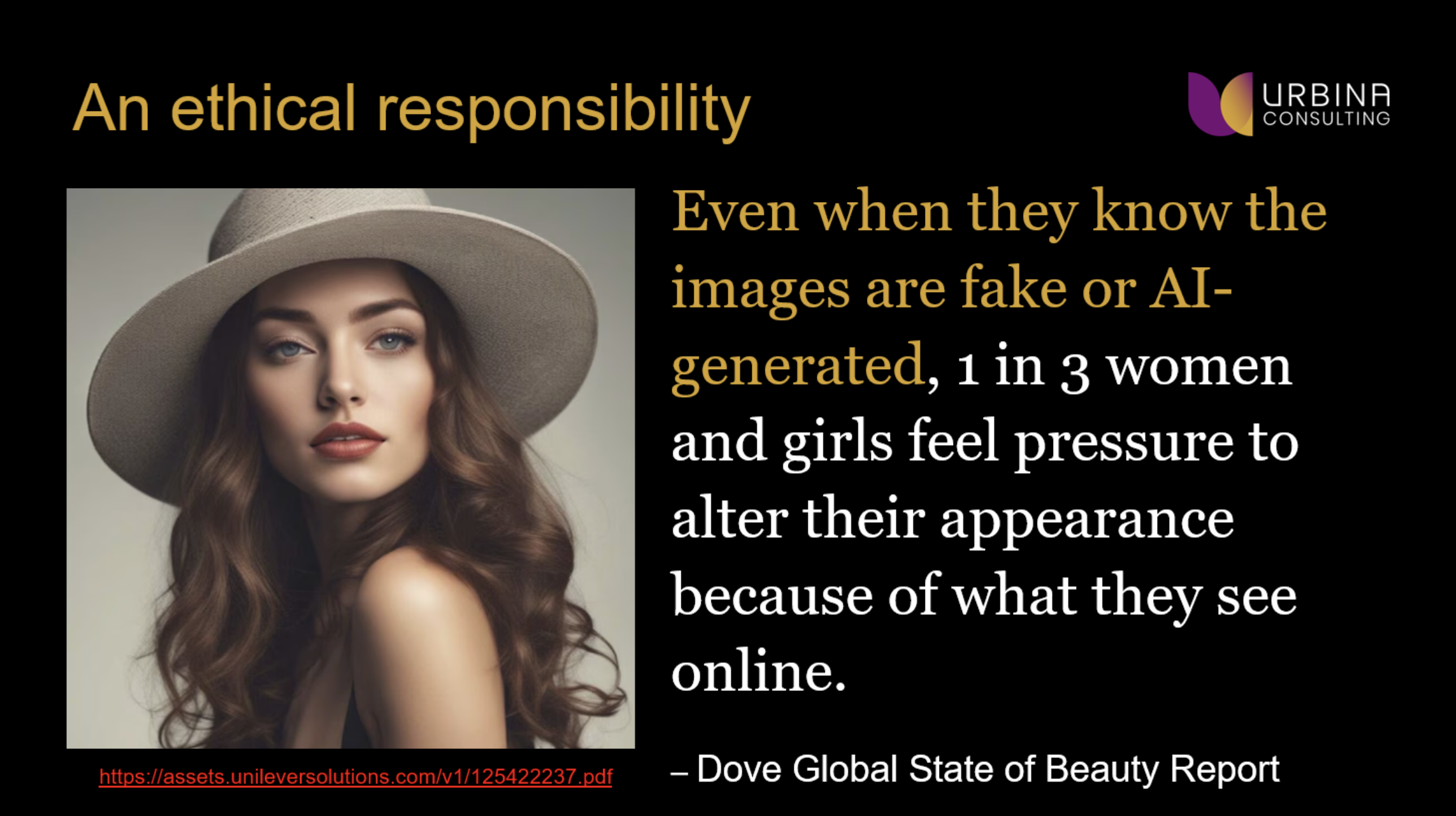
We’re squishy mammals in a complex digital world. We prefer the lies we like over the truths we don’t, we are predictably irrational, and we did not evolve to process this kind or level of input.
Technology is applied philosophy
What I don’t think enough people are discussing is a fundamental truth: technology is really “applied philosophy”. Google “Ethics: the trolley problem” and you’ll find the age-old dilemma: if a runaway train trolley was going to kill either a family or a single person, would you be the one to flip the switch and decide who dies? These ethical dilemmas, which have stumped great thinkers for centuries, are now being codified by Silicon Valley. A Tesla in an emergency may need to make exactly these kinds of decisions. When we hear the term “AI Ethics” – whose ethics are we really talking about?
We must question the narratives of leading brands and ask those with an influence over design and tech decisions to consider what should be done, not just what could be done. We have an ethical imperative to consider abuses, and even say no to stakeholders and clients who ask for features that could lead to harm.
In brands we trust
At the end of the day, we’re putting our trust in corporations. That chills me to the bone. The alarming history of corporate exploitation goes back to their inception and has left marks on society like leaded gas, forever chemicals, nicotine and fentanyl addiction, the many ills and perils of social media, and yes, even slavery. These are the entities unleashing non-human intelligences with bias and cultural perspectives into the world.
But it’s not all doom and gloom. I think there are ways to think more critically about AI and content and protect ourselves from manipulation. Like it or not, government regulation has to play a role in reining in corporate overreach. With the right conversation and active participation in institutions, there is hope for a better future, or at least a less painful one.
Truth Collapse
I am trying to start more productive dialogues about something that impacts all of us, whether we’re in “the industry” or not. Technology has intimate interactions with society, and they’re often negative, even dangerous. How can we minimise the transition pains while maximising benefits?
I usually talk about how we can be productive and extract and deliver value. But I want to discuss the potential costs, too.
The sooner the bubble of unrealistic expectations, nonsense marketing, and AI-washing (throwing the term “AI” on any product or brand to profit from the hype) bursts, the better for everyone, everywhere. It means, like with the internet bubble, we’ll be left with masses of infrastructure and capability we can start putting to good use. But there are many significant risks along the way.
Everything I’ve touched on can very possibly lead us to a state of what I call “Truth Collapse”. Truth Collapse is when our relationships with each other and ourselves is significantly undermined by the confusing and seductive mixture of the algorithmic and biological.
When the Printing Press enabled the Gutenberg Bible, it led not to consensus, but to violence. Niall Ferguson (whose politics I don’t defend, by the way) said, “The only law of history is the law of unintended consequences. (source)” Sam Altman, CEO of OpenAI said, “My worst fear is that we, the industry, cause significant harm to the world. I think, if this technology goes wrong, it can go quite wrong” (source).
We’re only at the start of this journey. Let’s be careful.
Keep the discussion going
If you’re interested in the kind of topics I’ve touched on here, OmnichannelX has released a 3-part podcast miniseries called “Rethinking AI” that is both a rethink for AI in business, and a wake-up call for anyone who cares about the future of technology and society.
This series is a thematic a bridge to a new area of focus. We are also launching a new site and podcast on Truthcollapse.com. It’s a forum to go deeper into the risks of algorithmification, the systemic drivers accelerating them, and potential ways around them. It won’t focus on omnichannel or business productivity, but we hope it will be a useful addition to the conversation for those in the industry and beyond to understand the world we’re living in, and hopefully make it better.
Session Series
Rethinking AI miniseries
3 sessions available.A free podcast miniseries zooming out to question the psychological, social, and even cultural impacts of AI and algorithmic experiences. This is a non-techie journey from getting a new mindset for applying AI at work, to discussing its worst dangers and how we can avoid them.

